
RBI

How Recent RBI Rate Cut Impacts Home Loan EMI in India

How Recent RBI Rate Cut Impacts Home Loan EMI in India: Complete Guide with Examples (2025)

What is the Current RBI Repo Rate in 2025?

The Reserve Bank of India has reduced the repo rate to 5.25% as of December 2025, marking the fourth consecutive rate cut this year with a cumulative reduction of 125 basis points from the initial 6.50%. This significant monetary policy shift has created substantial opportunities for home loan borrowers across India to reduce their monthly financial burden.

Understanding RBI Rate Cut and Its Direct Impact

What is Repo Rate?

The repo rate is the interest rate at which the Reserve Bank of India lends short-term funds to commercial banks against government securities. When the RBI reduces this rate, banks can borrow money at a cheaper cost, which typically translates to lower lending rates for consumers.

Why Did RBI Cut Rates in 2025?

The rate cuts were implemented amid confidence in a softer inflation outlook, with headline inflation revised down to 2.0% from 2.6%, keeping it well within the central bank’s 2-6% target range. The RBI aims to boost economic growth while maintaining price stability.

How RBI Rate Cut Reduces Your Home Loan EMI

When the RBI cuts the repo rate, the impact flows through the banking system in the following way:

  1. Banks’ Borrowing Cost Decreases: Commercial banks can now borrow from RBI at 5.25% instead of the earlier 6.50%
  2. Lending Rates Adjusted: Banks typically pass on this benefit by reducing their home loan interest rates
  3. Lower EMI for Borrowers: Reduced interest rates directly translate to lower Equated Monthly Installments

Types of Home Loans Affected

Floating Rate Home Loans: These loans are directly linked to external benchmarks like the repo rate. Any adjustments to the repo rate will likely be reflected in your EMI outlay considerably more quickly.

Fixed Rate Home Loans: These remain unaffected by repo rate changes and maintain the same interest rate throughout the tenure.

Real-Life Example: EMI Reduction Calculator

Let’s understand the actual savings with practical examples for different loan amounts:

Example 1: ₹30 Lakh Home Loan Over 20 Years

Scenario Before Rate Cut (at 8.90% interest rate):

  • Loan Amount: ₹30,00,000
  • Interest Rate: 8.90% per annum
  • Tenure: 20 years (240 months)
  • Monthly EMI: ₹27,435
  • Total Interest Payable: ₹35,84,400
  • Total Amount Payable: ₹65,84,400

Scenario After Rate Cut (at 8.00% interest rate):

  • Loan Amount: ₹30,00,000
  • Interest Rate: 8.00% per annum
  • Tenure: 20 years (240 months)
  • Monthly EMI: ₹25,093
  • Total Interest Payable: ₹30,22,320
  • Total Amount Payable: ₹60,22,320

Monthly Savings: ₹2,342 Total Interest Savings: ₹5,62,080 over 20 years

Example 2: ₹50 Lakh Home Loan Over 25 Years

Scenario Before Rate Cut (at 8.90% interest rate):

  • Loan Amount: ₹50,00,000
  • Interest Rate: 8.90% per annum
  • Tenure: 25 years (300 months)
  • Monthly EMI: ₹42,835
  • Total Interest Payable: ₹78,50,500
  • Total Amount Payable: ₹1,28,50,500

Scenario After Rate Cut (at 8.00% interest rate):

  • Loan Amount: ₹50,00,000
  • Interest Rate: 8.00% per annum
  • Tenure: 25 years (300 months)
  • Monthly EMI: ₹38,597
  • Total Interest Payable: ₹65,79,100
  • Total Amount Payable: ₹1,15,79,100

Monthly Savings: ₹4,238 Total Interest Savings: ₹12,71,400 over 25 years

Example 3: ₹1 Crore Home Loan Over 30 Years

Scenario Before Rate Cut (at 8.90% interest rate):

  • Loan Amount: ₹1,00,00,000
  • Interest Rate: 8.90% per annum
  • Tenure: 30 years (360 months)
  • Monthly EMI: ₹80,331
  • Total Interest Payable: ₹1,88,92,360
  • Total Amount Payable: ₹2,88,92,360

Scenario After Rate Cut (at 8.00% interest rate):

  • Loan Amount: ₹1,00,00,000
  • Interest Rate: 8.00% per annum
  • Tenure: 30 years (360 months)
  • Monthly EMI: ₹73,376
  • Total Interest Payable: ₹1,64,15,360
  • Total Amount Payable: ₹2,64,15,360

Monthly Savings: ₹6,955 Total Interest Savings: ₹24,77,000 over 30 years

When Will Borrowers See the Impact?

The transmission of rate cuts to existing home loan borrowers depends on several factors:

For New Home Loan Applicants

New borrowers can immediately benefit from the reduced rates when applying for home loans. Banks have started offering loans with interest rates beginning at 7.90% to 8.50% per annum.

For Existing Home Loan Borrowers

  • Repo-Linked Loans: Changes reflect immediately or within the next billing cycle
  • MCLR-Linked Loans: Changes reflect on the reset date (typically annually)
  • Base Rate Loans: Changes at the discretion of banks during periodic reviews

Following the rate cut decision, some banks have lowered their lending rates and FD rates, though the exact timing varies across different financial institutions.

Which Banks Have Reduced Home Loan Rates?

Major banks and housing finance companies in India typically adjust their lending rates following RBI announcements. Here’s what borrowers should look for:

Current Home Loan Interest Rates (December 2025)

  • HDFC Bank: Starting from 7.90% per annum
  • SBI Home Loans: 7.95% – 8.60% per annum
  • ICICI Bank: 8.00% – 8.75% per annum
  • Axis Bank: 8.05% – 8.80% per annum
  • LIC Housing Finance: 8.00% – 8.50% per annum

Note: Actual rates may vary based on credit profile, loan amount, and tenure. Always verify current rates with respective banks.

How to Calculate Your New EMI After Rate Cut

EMI Calculation Formula

EMI = [P × r × (1+r)^n] / [(1+r)^n – 1]

Where:

  • P = Principal loan amount
  • r = Monthly interest rate (Annual rate ÷ 12 ÷ 100)
  • n = Loan tenure in months

Quick EMI Calculation Steps

  1. Determine your current interest rate: Check your loan agreement or recent statement
  2. Calculate expected new rate: Subtract the repo rate reduction impact (typically 0.40% to 0.90%)
  3. Use an EMI calculator: Input new parameters to see revised EMI
  4. Contact your bank: Confirm the exact rate reduction and effective date

Maximizing Benefits from RBI Rate Cut

1. Refinance Your Existing Loan

If your current lender hasn’t reduced rates proportionately, consider:

  • Comparing rates across multiple banks
  • Negotiating with your existing bank
  • Exploring balance transfer options

2. Opt for Shorter Tenure

Instead of reducing EMI, you can maintain the same EMI amount and:

  • Reduce your loan tenure significantly
  • Save lakhs in interest payments
  • Become debt-free faster

Example: For a ₹30 lakh loan at 8.00% with ₹27,435 EMI (original EMI at 8.90%), you could reduce tenure from 20 years to approximately 17.5 years, saving ₹3+ lakhs in interest.

3. Make Prepayments

Prepayments reduce principal, saving future interest. Many banks in India don’t charge extra for prepayment of floating rate loans. Use your EMI savings to make annual prepayments.

4. Switch to Repo-Linked Loans

Transmissions are faster with repo-linked rates, as any adjustments to the repo rate will likely be reflected in your EMI outlay considerably more quickly.

Tax Benefits on Home Loans in India

Even with reduced EMIs, homebuyers continue to enjoy substantial tax benefits:

Section 80C Deduction

  • Deduction limit: Up to ₹1.5 lakh per year on principal repayment
  • Applicable for: Self-occupied and let-out properties
  • Conditions: Property should not be sold within 5 years

Section 24(b) Deduction

  • Deduction limit: Up to ₹2 lakh per year on interest payments
  • Self-occupied property: ₹2 lakh limit
  • Let-out property: No upper limit on interest deduction

Section 80EE (First-Time Buyers)

  • Additional deduction: Up to ₹50,000 on interest
  • Eligibility: First-time homebuyers
  • Property value: Not exceeding ₹50 lakhs
  • Loan amount: Not exceeding ₹35 lakhs

Future Rate Cut Expectations

Economic Projections for 2025-26

The RBI raised its GDP growth forecast for FY2025/26 to 7.3%, up from its earlier estimate of 6.8%. With inflation under control and growth momentum improving, there’s potential for:

  • Maintaining the current neutral stance
  • Possible stability in rates for upcoming quarters
  • Focus on supporting economic growth

What Borrowers Should Watch

  • Monthly inflation data releases
  • RBI Monetary Policy Committee meetings (held bi-monthly)
  • Global economic conditions and crude oil prices
  • Bank lending rate adjustments

Common Questions About RBI Rate Cut and Home Loans

Will my existing home loan EMI automatically decrease?

It depends on your loan type. Repo-linked loans see automatic changes, while MCLR-linked loans change on reset dates. Contact your bank for specific timelines.

Should I switch from fixed to floating rate now?

With rates at multi-year lows, floating rates offer better value. However, consider your risk appetite and loan tenure before switching.

How much will I actually save?

Savings depend on your loan amount, remaining tenure, and the extent of rate reduction your bank passes on. Use the examples above as reference points.

Is this a good time to buy property?

Lower rates encourage households to buy homes and boost spending, while companies can invest in new projects due to cheaper credit. Combined with favorable interest rates, this could be an opportune time.

Can banks refuse to pass on rate cuts?

Banks have the discretion to determine their lending rates, though competitive pressure usually ensures most rate cuts are transmitted to customers within a few months.

Actionable Steps for Home Loan Borrowers

Immediate Actions (This Month)

  1. Review your loan statement: Identify your current interest rate and linking mechanism
  2. Contact your lender: Inquire about rate revision timeline and quantum
  3. Calculate potential savings: Use EMI calculators with reduced rates
  4. Compare market rates: Check if other banks offer better terms

Medium-Term Strategy (3-6 Months)

  1. Consider balance transfer: If your bank hasn’t reduced rates adequately
  2. Restructure your loan: Opt for shorter tenure or repo-linked rates
  3. Plan prepayments: Allocate your EMI savings toward principal reduction
  4. Document benefits: Track actual savings for tax and financial planning

Long-Term Planning (1-2 Years)

  1. Monitor RBI policies: Stay informed about future rate changes
  2. Review annually: Assess if your loan terms remain competitive
  3. Build emergency fund: Use EMI savings to strengthen financial security
  4. Invest wisely: Deploy savings into wealth-building instruments

Conclusion: Making the Most of Lower Interest Rates

The RBI’s reduction of the repo rate to 5.25% makes borrowing cheaper for individuals and businesses, encouraging spending and investment. For home loan borrowers in India, this translates to substantial monthly savings and reduced interest burden over the loan tenure.

Whether you’re taking a new home loan or servicing an existing one, understanding how these rate cuts impact your finances empowers you to make informed decisions. With potential monthly savings ranging from ₹2,000 to ₹7,000 depending on your loan amount, and total interest savings running into lakhs of rupees, the cumulative benefit is significant.

The key is to stay proactive—monitor your loan terms, compare market offerings, and leverage the reduced rates to accelerate your journey toward financial freedom and homeownership goals.

Key Takeaways

✅ RBI has cut repo rate to 5.25% in December 2025, a reduction of 125 basis points this year

✅ Home loan borrowers can save ₹2,342 to ₹6,955 monthly on loans ranging from ₹30 lakh to ₹1 crore

✅ Repo-linked loans see faster transmission of rate cuts compared to MCLR-linked loans

✅ Total interest savings can range from ₹5.62 lakh to ₹24.77 lakh over loan tenure

✅ Consider shorter tenure or prepayments instead of just reducing EMI for maximum benefit

✅ Continue to enjoy tax benefits under Sections 80C, 24(b), and 80EE despite lower EMIs

✅ Monitor your lender’s rate revision and compare with market offerings regularly


Disclaimer: The examples and calculations provided are illustrative. Actual EMI amounts may vary based on individual loan terms, bank policies, and processing fees. Always verify current interest rates and loan conditions with your respective lender before making financial decisions.

Last Updated: December 2025 | Sources: Reserve Bank of India, Major Banks’ Official Websites


RBI

RBI’s Unified Lending Interface(ULI): Revolutionizing Credit Access in India

Unified Lending Interface (ULI)

The Reserve Bank of India (RBI) is about to introduce the Unified Lending Interface (ULI), a digital platform that has the potential to completely change the lending market in India. This is a historic move. With the Unified Payments Interface (UPI) having revolutionized real-time payments, the ULI seeks to satisfy the large unmet demand for loans across diverse sectors and improve lending operations.

Bridging the Credit Gap in India

The ULI is primarily intended to serve underprivileged populations, with an emphasis on Micro, Small, and Medium-Sized Enterprises (MSME) and agricultural borrowers. This cutting-edge platform claims to streamline and accelerate the lending process by utilizing cutting-edge technology, increasing financial accessibility for those who most need it.

Key Features of the Unified Lending Interface (ULI)

  1. Data integration: ULI makes it easier for lenders to receive digital data, including land records, from a variety of data service providers.
  2. Standardized APIs: To facilitate plug-and-play access to a variety of information sources, the platform makes use of common and standardized Application Programming Interfaces (APIs).
  3. Consent-based business system: By using a consent-based business model, ULI safeguards borrower data and places a high priority on data privacy.
  4. Reduced complexity: By streamlining technical integrations, ULI simplifies the lending process for both borrowers and lenders.
  5. Quicker turnaround times: The platform aims to significantly reduce the time required for credit appraisal, especially for smaller and rural borrowers.

From Pilot to Nationwide Launch

The ULI is currently in its pilot phase and will soon be implemented nationally, according to a recent announcement made by RBI Governor Shaktikanta Das. Speaking in Bengaluru at the Global Conference on Digital Public Infrastructure and Emerging Technologies, Das emphasized his belief that ULI would change payments and, in the same way, overhaul the lending ecosystem in India.

The JAM-UPI-ULI Trinity

Governor Das introduced the concept of a new trinity in India’s digital infrastructure journey: JAM-UPI-ULI. It is anticipated that this development from the previous Jan Dhan-Aadhaar-Mobile (JAM) trinity will represent a seismic shift in the nation’s financial technology environment..

Implications for Stakeholders

The launch of ULI holds significant implications for various stakeholders in the financial sector:

  1. Borrowers: easier access to credit with reduced documentation and faster processing times.
  2. Lenders: Enhanced ability to assess creditworthiness and streamline lending operations.
  3. MSMEs: improved access to formal credit, potentially boosting growth and economic contribution.
  4. Agriculture: It might be simpler for farmers to obtain financing for equipment and inputs, particularly tenant farmers.

The Future of Digital Lending in India

The ULI is a critical step toward a more equitable and effective lending ecosystem as India advances financially technology. The RBI seeks to provide new avenues for financial inclusion and economic growth by using digital infrastructure and solving the issues underprivileged sectors experience.

The Unified Lending Interface is poised to transform the financial environment in India with its upcoming statewide deployment. This cutting-edge technology has the potential to become the industry standard for digital lending solutions as it develops.

Source: 

RBI

RBI Pravaah Portal

A New Era of Digital Regulation: RBI Unveils ‘PRAVAAH’

In a groundbreaking move to modernize and streamline its processes, the Reserve Bank of India (RBI) has launched ‘PRAVAAH’ – a cutting-edge, web-based platform designed to revolutionize the way regulatory approvals, licenses, and authorizations are obtained.

PRAVAAH marks a significant milestone in the RBI’s digital transformation journey, offering a secure, centralized hub for individuals and entities to seamlessly interact with India’s central bank. This innovative portal is equipped with a range of user-friendly features aimed at simplifying and accelerating the regulatory application process.

Gone are the days of navigating complex bureaucratic mazes and enduring lengthy delays. PRAVAAH is poised to become a game-changer, providing much-needed transparency and efficiency to a process that has historically been plagued by opaqueness and bottlenecks.

By leveraging the power of technology, the RBI is demonstrating its commitment to addressing the long-standing challenges faced by applicants, including lack of visibility into the application status and protracted decision-making timelines.

PRAVAAH is not just a portal; it’s a testament to the RBI’s unwavering dedication to supporting India’s dynamic financial sector. By simplifying interactions and expediting decision-making, the platform is expected to benefit a wide range of stakeholders, from banks and financial institutions to various entities seeking regulatory approvals.

The launch of PRAVAAH comes at a pivotal moment when digital transformation is paramount for enhancing the efficiency of financial regulatory bodies worldwide. As the RBI continues to innovate and adapt to the evolving landscape, PRAVAAH represents a significant stride forward in its mission to support India’s thriving financial ecosystem.

This groundbreaking initiative is poised to set a precedent for how technology can be harnessed to improve governance, service delivery, and ultimately, the entire regulatory experience. PRAVAAH is a shining example of the RBI’s commitment to fostering a transparent, efficient, and responsive regulatory environment in India – paving the way for a new era of digital regulatory management.

RBI

RBI Monetary Policy 2024 Key Highlights

RBI Monetary Policy 2024 Key Highlights

What is Monetary Policy?

Monetary policy refers to the actions taken by a central bank, like the RBI in India or the Federal Reserve in the US, to manage a country’s money supply and influence economic activity. It’s basically a toolbox for fine-tuning the economy.

Here’s how it works:

  • Central bank control: The central bank acts as the main driver of monetary policy. It implements various tools to achieve economic goals like price stability (low and predictable inflation) and maximum employment.

  • Tools of the trade: There are a few key tools central banks use:

    • Interest rates: By raising or lowering interest rates, the central bank can influence borrowing costs. Lower rates make borrowing cheaper, encouraging spending and investment, which can boost economic activity. Higher rates have the opposite effect, aiming to curb inflation.
    • Open market operations: This involves buying or selling government bonds in the open market. Buying bonds injects money into the system, while selling bonds does the opposite. This helps control the overall money supply.
    • Reserve requirements: These are the minimum amounts of cash banks must hold as reserves. Changing these requirements can influence how much banks can lend out, impacting the money circulating in the economy.
  • Objectives in mind: The main goals of monetary policy are:

    • Price stability: Keeping inflation low and stable is crucial for healthy economic growth.
    • Maximum employment: Promoting full employment by fostering conditions for businesses to create jobs.
    • Economic growth: Monetary policy can help stimulate economic growth by encouraging investment and spending.

Overall, monetary policy plays a significant role in managing economic fluctuations and steering the country towards a stable and prosperous future.

The Reserve Bank of India (RBI)’s Monetary Policy Committee (MPC) voted unanimously to keep the repo rate unchanged at 6.50% in its bimonthly policy review on April 5, 2024. This marks the fourth consecutive meeting where rates have been left untouched.

RBI Governor Shaktikanta Das stated that India’s GDP growth for 2024-25 is projected at 6.8%, slightly lower than the 7% forecast earlier. He cited moderating external demand and tightening global financial conditions as factors weighing on the growth outlook.

On inflation, Das said consumer price rise is expected to average 5.1% in the current fiscal year, remaining above the RBI’s tolerance band of 2-6% for a third straight year. However, the central bank expects inflation to ease gradually and return within the target range in the second half of 2024-25.

The RBI reiterated its focus on withdrawal of accommodation to ensure inflation remains within the target going forward, while supporting economic growth

The Reserve Bank of India (RBI) just announced its first bi-monthly monetary policy for the financial year 2024-25 (as of April 5, 2024). Here are the key takeaways:

  • Repo Rate Unchanged: The RBI decided to maintain the repo rate, the key short-term lending rate, at 6.5% for the seventh consecutive meeting. This indicates a continuation of the policy stance to control inflation.
  • Focus on Inflation Control: Governor Shaktikanta Das emphasized the need for continued disinflationary measures despite positive economic growth projections.
  • Economic Growth Forecast Maintained: The RBI retained its economic growth forecast for FY25 at 7%. This optimism stems from factors like strengthening rural demand, improving job market, and a pick-up in manufacturing.
  • Dissenting Vote: One member of the Monetary Policy Committee (MPC) advocated for a rate cut, expressing concerns that current rates might hinder economic growth.

The policy stance keeps the door open for further rate hikes if inflation does not fall as expected over the coming months.

RBI

ONDC Explained: Open Network for Digital Commerce in India

Open Network for Digital Commerce (ONDC) is a network based on open protocol and will enable local commerce across segments, such as mobility, grocery, food order and delivery, hotel booking and travel, among others, to be discovered and engaged by any network-enabled application.

What is ONDC?

ONDC stands for Open Network for Digital Commerce. It is a government-backed initiative to create a unified open platform for all aspects of the digital commerce ecosystem in India. ONDC is designed to be open, transparent, and non-discriminatory, and it will allow businesses of all sizes to participate in the digital commerce market.

Benefits of ONDC

ONDC is expected to bring a number of benefits to the Indian digital commerce market, including:

  • Increased competition and choice for consumers: ONDC will create a level playing field for all businesses, large and small, which will lead to increased competition and choice for consumers.
  • Lower prices: Increased competition is expected to lead to lower prices for goods and services on the ONDC platform.
  • Improved efficiency: ONDC is expected to improve the efficiency of the digital commerce market by streamlining processes and reducing costs.
  • Increased access to markets: ONDC will make it easier for businesses, especially small businesses and MSMEs, to reach a wider audience and grow their businesses.
  • Increased transparency: ONDC will increase transparency in the digital commerce market by making it easier for consumers to compare prices and products.
  • Protection of consumers: ONDC will protect consumers by providing a framework for resolving disputes and ensuring fair practices.

How does ONDC work?

ONDC is a two-sided platform that connects buyers and sellers. Buyers can search for products and services on the ONDC platform, and sellers can list their products and services for sale. ONDC does not own any inventory or take any commission on transactions. It simply provides the platform for buyers and sellers to interact.

ONDC uses open standards, which means that any business can participate in the platform. This will help to ensure that ONDC is a truly open and inclusive platform.

Current status of ONDC

ONDC is still in its early stages of development, but it has already made significant progress. The pilot phase of ONDC was launched in April 2022, and it is currently available in 100 cities across India. The government plans to roll out ONDC nationwide by the end of 2023.

Conclusion

ONDC is a major initiative that has the potential to revolutionize the digital commerce landscape in India. It is expected to bring a number of benefits to businesses and consumers, including increased competition, lower prices, improved efficiency, and increased access to markets. ONDC is still in its early stages of development, but it has already made significant progress. The government plans to roll out ONDC nationwide by the end of 2023.

Here are some additional resources you may find helpful:

RBI

OCEN – India’s Open Credit Enablement Network

What is OCEN?

The Open Credit Enablement Network (OCEN) is a set of open standards that facilitate the flow of credit between borrowers, lenders, and credit distributors. It is designed to accelerate digital lending and make credit more accessible to individuals and businesses.

Open Credit Enablement Network (OCEN) is an open, interoperable platform that enables the sharing of credit information between financial institutions. It is a public-private partnership between the Reserve Bank of India (RBI), the National Payments Corporation of India (NPCI), and a consortium of banks and other financial institutions.

OCEN was launched in 2023 with the aim of making it easier for borrowers to obtain credit and for financial institutions to assess the creditworthiness of borrowers. The platform allows financial institutions to share credit information about their customers with other financial institutions, such as loan histories, repayment records, and other relevant data. This information can be used by financial institutions to make more informed lending decisions.

The OCEN has the potential to have a significant impact on the Indian credit market. It can:

  • Increase credit access: The OCEN can help to break down the barriers to credit access by providing a common platform for lenders and borrowers to interact. This can make it easier for borrowers to get the credit they need, even if they have limited financial history or documentation.
  • Reduce costs: The OCEN can help to reduce the costs of lending by streamlining the credit approval process and making it easier for lenders to share information. This can make credit more affordable for borrowers.
  • Improve efficiency: The open Credit Enablement Network can help to improve the efficiency of the credit market by making it easier for lenders to find borrowers and for borrowers to find lenders. This can lead to a more competitive lending market and better loan terms for borrowers.
  • Increase transparency: The OCEN can help to increase transparency in the credit market by making it easier for borrowers to understand the terms of their loans. This can help to protect borrowers from predatory lending practices.

The OCEN is still in its early stages of development, but it has the potential to be a major force in the Indian credit market. It is expected to have a significant impact on the availability, cost, and efficiency of credit in India.

Here are some specific examples of how the OCEN can impact the Indian credit market:

  • It can help to increase access to credit for MSMEs: MSMEs are a major driver of economic growth in India, but they often face challenges in accessing credit. The OCEN can help to address these challenges by providing a platform for MSMEs to connect with lenders and by making it easier for lenders to assess the creditworthiness of MSMEs.
  • It can help to reduce the cost of credit: The OCEN can help to reduce the cost of credit by making it easier for lenders to share information and by streamlining the credit approval process. This can make credit more affordable for MSMEs and other borrowers.
  • It can help to improve the efficiency of the credit market: The OCEN can help to improve the efficiency of the credit market by making it easier for lenders to find borrowers and for borrowers to find lenders. This can lead to a more competitive lending market and better loan terms for borrowers.
  • It can help to increase transparency in the credit market: The OCEN can help to increase transparency in the credit market by making it easier for borrowers to understand the terms of their loans. This can help to protect borrowers from predatory lending practices.

OCEN is an API framework that will allow lenders and borrowers to come on the same platform and interact easily.

Overall, the OCEN has the potential to be a major force in the Indian credit market. It is expected to have a significant impact on the availability, cost, and efficiency of credit in India.

Read Article: OCEN

RBI

What is Frictionless Credit

Frictionless credit is a term used to describe the process of obtaining credit that is quick, easy, and convenient. It is made possible by the use of technology to automate and streamline the lending process.

The traditional lending process can be time-consuming and cumbersome, involving a lot of paperwork and manual verification. Frictionless credit aims to eliminate these obstacles by using technology to automate the process of credit assessment and approval.

There are a number of benefits to frictionless credit. For borrowers, it can make it easier to get the credit they need when they need it. For lenders, it can reduce the cost of lending and improve the efficiency of their operations.

There are a number of technologies that can be used to create frictionless credit. These include:

  • Artificial intelligence (AI) can be used to automate the assessment of creditworthiness.
  • Blockchain can be used to create a secure and transparent record of lending transactions.
  • Big data can be used to identify borrowers who are good credit risks.
  • Machine learning can be used to develop algorithms that can predict the likelihood of a borrower defaulting on a loan.

The use of technology to create frictionless credit is still in its early stages, but it has the potential to revolutionize the lending industry.

Here are some of the key benefits of frictionless credit:

  • Speed: The lending process can be completed much faster, which can be a major advantage for borrowers who need quick access to credit.
  • Efficiency: The use of technology can help to streamline the lending process, which can save lenders time and money.
  • Accuracy: The use of technology can help to improve the accuracy of credit decisions, which can reduce the risk of defaults.
  • Accessibility: Frictionless credit can make it easier for people to get the credit they need, regardless of their credit history or financial situation.

Overall, frictionless credit has the potential to make the lending process more efficient, accessible, and affordable for everyone.

Here are some of the challenges to implementing frictionless credit:

  • Data privacy: The use of big data and machine learning raises concerns about data privacy. Lenders need to be careful about how they collect and use borrower data.
  • Cybersecurity: The use of technology also makes the lending process more vulnerable to cyberattacks. Lenders need to take steps to protect their systems from hackers.
  • Regulation: The use of frictionless credit may require new regulations to ensure that it is used fairly and responsibly.

Despite these challenges, the potential benefits of frictionless credit are significant. As the technology continues to develop, it is likely that frictionless credit will become more widespread in the future.

RBI

RBI Pilot Project for Public Tech Platform for Frictionless Credit

Reserve Bank of India to Launch the Pilot Project for Public Tech Platform for Frictionless Credit

Click Here to see the RBI Press Release

What is public tech platform frictionless credit?
The Public Tech Platform for frictionless credit is an end-to-end digital platform that has been developed by the Reserve Bank Innovation Hub, a wholly-owned subsidiary of the central bank

The Reserve Bank of India (RBI) has launched a pilot project for a public tech platform for frictionless credit. The platform will be an end-to-end digital platform with an open structure, open APIs, and established standards. This will allow all participants in the financial sector to integrate with the platform seamlessly, using a “plug and play” approach.

The RBI said that the platform will foster efficiency in the lending process by reducing costs, speeding up disbursement, and increasing scalability. It will do this by streamlining the flow of information between lenders and borrowers, and by making it easier for lenders to assess the creditworthiness of borrowers.

The platform will initially focus on four products: Kisan Credit Card loans, dairy loans, MSME loans, and personal loans. It will be rolled out in a phased manner, with more products being added in the future.

The RBI said that the platform is a significant step towards making credit more accessible and affordable for all Indians. It is also a step towards making the Indian financial system more efficient and competitive.

Here are some specific ways in which the platform will foster efficiency in the lending process:

  • Reduced costs: The platform will allow lenders to share data and information more easily, which will reduce the need for duplicate documentation and verification. This will save lenders time and money.
  • Quicker disbursement: The platform will make it easier for lenders to assess the creditworthiness of borrowers, which will speed up the loan approval process.
  • Increased scalability: The platform is designed to be scalable, so it can be easily adapted to meet the needs of a growing number of borrowers and lenders.

The platform is a major initiative by the RBI to improve access to credit in India. It is a step towards a more efficient and competitive financial system that will benefit all Indians..

Who will it benefit with Public T Platform Frictionless Credit ?

The Reserve Bank of India (RBI) has announced that the pilot project for the Public Tech Platform for Frictionless Credit will focus on the following products:

  • Kisan Credit Card loans up to Rs 1.6 lakh per borrower
  • Dairy loans
  • MSME loans (without collateral)
  • Personal loans
  • Home loans

The platform will also enable linkage with a variety of services, including:

  • Aadhaar e-KYC
  • Land records from onboarded state governments (Madhya Pradesh, Tamil Nadu, Karnataka, Uttar Pradesh, and Maharashtra)
  • Satellite data
  • PAN Validation
  • Transliteration
  • Aadhaar e-signing
  • Account aggregation by account aggregators (AAs)
  • Milk pouring data from select dairy co-operatives
  • House/property search data

The RBI said that the scope and coverage of the platform will be expanded to include more products, information providers, and lenders during the pilot project. This will be done based on the learnings from the pilot.

The pilot project is scheduled to begin on August 17, 2023. It is a significant step towards making credit more accessible and affordable for all Indians. The platform is expected to reduce the cost and time of obtaining credit, and to make it easier for lenders to assess the creditworthiness of borrowers.

RBI

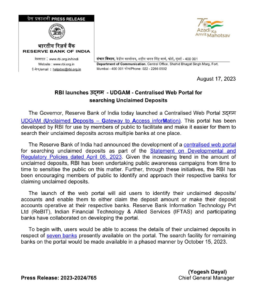
RBI Launches UDGAM, a Centralized Web Portal for Searching Unclaimed Deposits

UDGAM Stands for Unclaimed Deposits – Gateway to Access information

The Reserve Bank of India (RBI) has launched a centralised web portal called UDGAM (Unclaimed Deposits – Gateway to Access inforMation) to help people search for their unclaimed deposits across multiple banks. The portal was launched by RBI Governor Shaktikanta Das on August 17, 2023.

Click here to access the UDGAM website

Click here to Register

Important – Here’s the Official RBI Circular

RBI UDGAM Official Circular

Unclaimed deposits are those deposits that have remained inactive for a period of 10 years or more. Under the RBI’s Deposit Insurance and Credit Guarantee Corporation (DICGC) Act, 1961, such deposits are transferred to the Depositor Education and Awareness Fund (DEAF).

The UDGAM portal will allow users to search for their unclaimed deposits by entering their name, account number, or other details. The portal will also provide information on the amount of the unclaimed deposit, the bank where it is held, and the steps to claim it.

To begin with, the UDGAM portal will only have details of unclaimed deposits from seven banks. However, the RBI plans to add more banks to the portal in a phased manner by October 15, 2023.

The launch of the UDGAM portal is a significant step towards helping people claim their unclaimed deposits. It will also help to increase awareness about unclaimed deposits and the steps to claim them.

Here are the key features of the UDGAM portal:

  • It allows users to search for their unclaimed deposits across multiple banks.
  • It provides information on the amount of the unclaimed deposit, the bank where it is held, and the steps to claim it.
  • It is a user-friendly and secure portal.

How to use the UDGAM portal:

  1. Go to the UDGAM portal website.
  2. Click on the “Search for Unclaimed Deposits” tab.
  3. Enter your name, account number, or other details.
  4. Click on the “Search” button.
  5. The portal will display the results of your search.
  6. If you find your unclaimed deposit, you can contact the bank where it is held to claim it.

Currently 7 Banks are available on the UDGAM Portal.

1) State Bank of India
2) Punjab National Bank
3) Central Bank of India
4) Dhanlaxmi Bank Ltd
5) South Indian Bank Ltd
6) DBS Bank India Ltd
7) Citibank

The search facility for remaining banks on the portal would be made available in a phased manner by October 15, 2023

The UDGAM portal is a useful tool for people who are looking for their unclaimed deposits. It is a simple and secure way to search for unclaimed deposits across multiple banks.

The UDGAM portal has been developed by a collaborative effort of Reserve Bank Information Technology Pvt Ltd (ReBIT), Indian Financial Technology & Allied Services (IFTAS) and participating banks.

RBI

FLDG- First Loss Default Guarantee for Fintechs in India

Everything You Need to Know About FLDG Guidelines

FLDG stands for First Loss Default Guarantee. It is a risk-sharing arrangement between a regulated entity (RE), such as a bank or non-banking financial company (NBFC), and a fintech lending service provider (LSP). Under an FLDG arrangement, the LSP agrees to compensate the RE for any losses incurred on loans that are originated by the LSP and then sold to the RE.

The FLDG arrangement can be used to encourage REs to partner with LSPs to offer digital lending products. The FLDG provides the RE with protection against default risk, which makes them more willing to lend to borrowers who may not be able to obtain loans from traditional lenders.

The Reserve Bank of India (RBI) has recently approved the FLDG framework for NBFCS. The framework sets out the terms and conditions under which FLDG arrangements can be made.

The key features of the framework are as follows:

  • The FLDG can cover up to 5% of the loan portfolio of the RE.
  • The FLDG must be invoked within 120 days of the default.
  • The LSP must have adequate financial resources to meet its obligations under the FLDG.
  • The FLDG must be reviewed and renewed every year.

The FLDG framework is expected to boost the growth of digital lending in India. It will make it easier for banks and NBFCs to partner with fintechs to offer digital lending products, which will help to expand access to credit for borrowers.

Here are some of the benefits of FLDG for NBFCS:

  • It can help to reduce the risk of default for NBFCS.
  • It can make it easier for NBFCS to expand their lending operations.
  • It can help to increase competition in the lending market.
  • It can make it easier for borrowers to obtain loans.

Overall, FLDG is a positive development for the NBFCS sector. It is a risk-sharing mechanism that can help to promote the growth of digital lending in India.

Here are some examples of how FLDG can be used:

  • A bank partners with a fintech company to offer a digital lending product for small businesses. The fintech company originates the loans and then sells them to the bank. The bank is protected against default risk by the FLDG arrangement.
  • An NBFC partners with a fintech company to offer a digital lending product for farmers. The fintech company originates the loans and then sells them to the NBFC. The NBFC is protected against default risk by the FLDG arrangement.
  • A fintech company offers a digital lending product for borrowers with limited credit history. The fintech company guarantees the loans to the RE, which makes it easier for borrowers to obtain loans.

FLDG is a promising new development in the field of digital lending. It has the potential to make it easier for borrowers to obtain loans, expand the reach of financial services, and reduce the risk of default for lenders.

The FLDG (First Loss Default Guarantee) Guidelines are a set of regulations issued by the Reserve Bank of India (RBI) that govern the use of FLDG arrangements in digital lending. The guidelines were issued in June 2023 and are intended to promote the growth of digital lending by providing a framework for risk sharing between regulated entities (REs) and fintech lending service providers (LSPs)

In the context of NBFCS, FLDG can be used to encourage banks and NBFCs to partner with fintechs to offer digital lending products. The FLDG would provide the banks and NBFCs with protection against default risk, which would make them more willing to lend to borrowers who may not be able to obtain loans from traditional lenders.

The Reserve Bank of India (RBI) has recently approved the FLDG framework for NBFCS. The framework sets out the terms and conditions under which FLDG arrangements can be made.

The FLDG framework is expected to boost the growth of digital lending in India. It will make it easier for banks and NBFCs to partner with fintechs to offer digital lending products, which will help to expand access to credit for borrowers.

The key provisions of the FLDG Guidelines are as follows:

  • FLDG arrangements can only be entered into between REs and LSPs.
  • The FLDG can cover up to 5% of the loan portfolio of the RE.
  • The FLDG must be invoked within 120 days of the default.
  • The LSP must have adequate financial resources to meet its obligations under the FLDG.
  • The FLDG must be reviewed and renewed every year.

The FLDG Guidelines are a significant development in the field of digital lending. They provide a clear framework for risk sharing between REs and LSPs, which is expected to boost the growth of digital lending in India.

Here are some of the key benefits of the FLDG Guidelines:

  • They provide a clear framework for risk sharing between REs and LSPs.
  • They make it easier for REs to partner with LSPs to offer digital lending products.
  • They help to reduce the risk of default for REs.
  • They help to promote the growth of digital lending in India.

The FLDG Guidelines are a positive development for the digital lending sector in India. They are expected to make it easier for borrowers to obtain loans and expand the reach of financial services.

Here are some of the things to keep in mind about the FLDG Guidelines:

  • The FLDG can only be used for loans that are originated by the LSP and then sold to the RE.
  • The FLDG does not cover losses due to fraud or willful default by the borrower.
  • The FLDG must be reviewed and renewed every year.

If you are an RE or an LSP, you should familiarize yourself with t

Here are some of the benefits of FLDG for NBFCS:

  • It can help to reduce the risk of default for NBFCS.
  • It can make it easier for NBFCS to expand their lending operations.
  • It can help to increase competition in the lending market.
  • It can make it easier for borrowers to obtain loans.

Overall, FLDG is a positive development for the NBFCS sector. It is a risk-sharing mechanism that can help to promote the growth of digital lending in India.

If you are an RE or an LSP, you should familiarize yourself with the FLDG Guidelines. They are an important part of the regulatory framework for digital lending in India.